Complete Your Book in 28 Days

Everything you need on one page. For free. Now you can draft & publish your prescriptive nonfiction book in 28 days (or less). Start with a quick video overview.

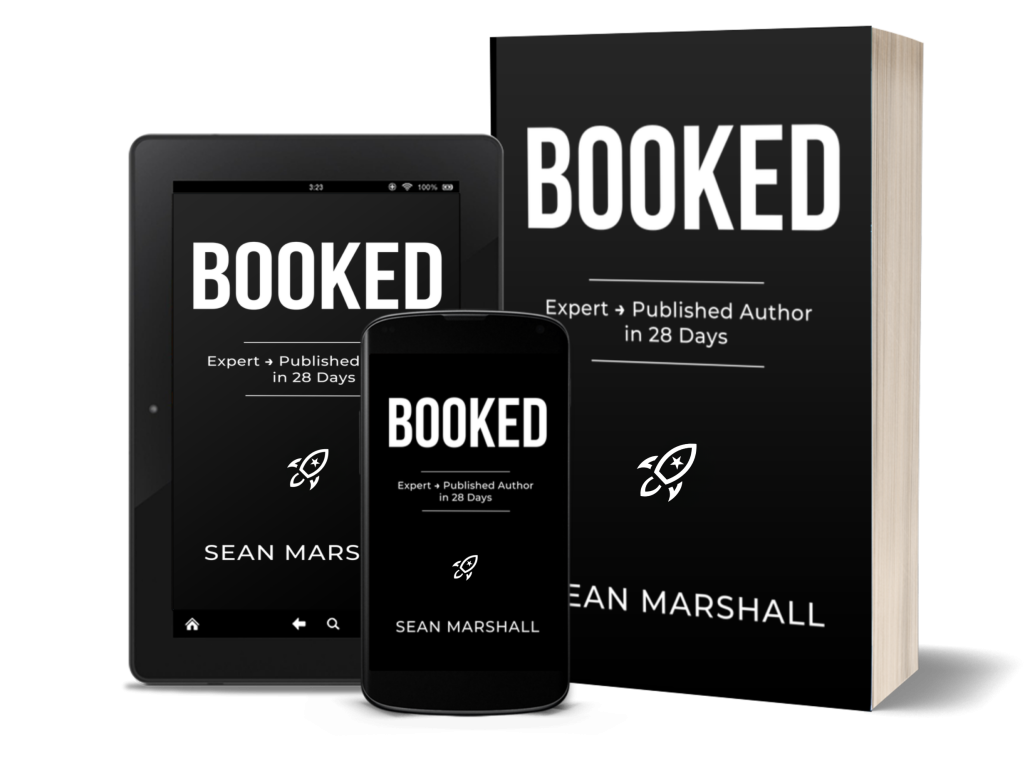
Booked Book Cover

Haven’t read the book yet? Grab a free copy of Booked here!

Your Voice. Your Name on the Cover.

You’ve spent years building your expertise.

We help you turn it into a book… in 28 days.

The 28-Day Playbook

Here it is. The mindset and the method distilled into a sequenced, day-by-day action plan.

Do the steps and go from “I want to write a book” to “I wrote a book.”

It’s broken into 4 phases:

Plan, Produce, Polish, Publish

PHASE I:

PLAN

Days 1–6

Clarity before content. This is where you lock in your reader, your framework, your chapter outline and all the goodness that makes the drafting phase fast and focused. Authors who invest here draft faster, revise less, and finish stronger.

Focus + Working Title + IDEA Method Path

The single most important day in the entire process. You’re locking in who your book is for, what it promises, and how you’ll produce it. Everything that follows flows from what you decide here.

  • Perfect Reader defined in one specific sentence
  • Proven Idea written in one sentence
  • Promised Outcome written as a clear Before and After
  • Your framework/method named with steps listed
  • One-Sentence Book Description using this template: [Book title] helps [Perfect Reader] [Proven Idea] so they can [Promised Outcome].

NOTE: This describes your book, not you. Your 1st-person version, the one you’ll say out loud at networking events, comes on Day 2.

  • Book Brief saved and accessible
  • Working title drafted using the Gain/Pain formula: maximize dream outcome and believability, minimize wait time and effort
  • IDEA Method path selected using the IDEA Method Selector
  • Required tools confirmed and ready: voice recorder, AI access, interview questions (if applicable)
  • If using the Expound path, interview partner scheduled today

Common pitfall: Trying to solve multiple problems. One problem. One book.

Elevator Pitch + Brainstorm

Your elevator pitch proves you’re ready to outline. If it clicks in one sentence, you’re ready to build. Then get everything out of your head.

  • Elevator Pitch written using the Mad Libs template: I help [Perfect Reader] through [Proven Idea] to get [Promised Outcome]
  • Elevator Pitch spoken out loud. Does it make someone lean in? (if not, refine until it does)
  • Existing content inventoried: blog posts, presentations, video transcripts, emails, proposals, social posts, SOPs
  • Authority inventory completed: credentials, certifications, years of experience, and most importantly, client results
  • Brainstorming session completed
  • Content sorted into loose theme buckets, no detail yet
  • Quick external research sprint done (1–2 hours max): competitor book reviews, YouTube comments, Reddit, BuzzAbout.ai, and AnswerThePublic

Outline

Bring order to the chaos. Your outline is the blueprint. It makes everything else better and so much easier.

  • AI theme-analysis prompt run on your brainstorm content to group ideas before manual sorting
  • 6-step outline process complete: Beginning, Middle, End sorted, then phases identified, then chapters broken out
  • Working title written for each chapter (one-sentence description, no specific details yet)
  • Chapter Outline Template filled in for each chapter: Hook, Story, Teaching headers, Action Step, Bridge
  • Chapter titles extracted to create your working Table of Contents

10 chapters is a guideline. If your chapters run shorter, you may end up with more. What matters is mapping your detailed process.

Chapter-Level Outlines, Chapters 1 to 5

Think scaffolding, not writing. Bullet points are fine. For each chapter, outline:

  • Hook: How will you open? What problem or tension grabs attention?
  • Story: What brief example or anecdote illustrates the point?
  • Teaching: What are the 3 to 5 main points or steps to cover?
  • Application: What specific action do you want readers to take that will help them?
  • Transition: One sentence connecting this chapter to the next

Time-saving tip: Talk through your outlines instead of typing. Wispr Flow or Google Docs’ voice typing are great tools for this!

Chapter-Level Outlines, Chapters 6 to 10-ish, Voice Prep

  • Same structure applied to Chapters 6 to 10: Hook, Story, Teaching, Application, Transition
  • Extra attention on Chapter 10 (or final chapter number): Reinforce the transformation arc, give clear next steps, end with inspiration
  • All chapter outlines read in sequence, gaps and weak transitions flagged

Voice Prep (do this before drafting begins):

  • Perfect Reader written as one specific sentence. This is the Taco Shop Principle: you’re writing to one person across from you, not a room full of strangers.
  • Eighth-grade reading level check: Paste a sample of your existing writing into AI and run the plain-language prompt. Use the result to calibrate your baseline before drafting.
  • 2 to 3 specific client stories noted for each chapter in your outline. These are the stories you’ll reach for when you draft.

Prepare + Pre-Draft Sprint

Today is your pre-game. Get your head right, your tools ready, and your content organized because tomorrow, you draft.

  • Why Statement written (one paragraph, personal, keep it visible): Why does this book need to exist, and why are you the one to write it?
  • Drafting toolkit set up: Capture tool, drafting tool, light editing tool. 3 to 5 tools total (work with what you’ve got and are familiar with)
  • The one non-negotiable rule locked in: Do not edit while you draft
  • Content Inventory Sprint complete (90 minutes): Book Inventory folder created and organized by chapter, all relevant content gathered
  • Content sorted by chapter, thin chapters identified, 3 to 5 key points noted for each
  • Author Bio drafted (150 to 200 words)
  • Dedication written (one sentence is enough)
  • Cover designer search started (Reedsy, 100Covers, 99designs, Fiverr)

PHASE II:

PRODUCE

Days 7–12

This is where your book actually gets drafted… and it’s faster than you think. With the IDEA Method, some people finish their entire first draft in a day or two. If you finish early, don’t wait. Move straight to Polish.

NOTE: The following steps are tied to a range rather than specific days

If you finish early, move straight into Phase III: Polish

Inventory Path: You have substantial existing content

  • Run AI Content Archaeologist pass on your inventory, extract, label, and sort by chapter
  • Fill content gaps with dictation for thin chapters
  • Use AI to shape extracted content into chapter drafts
  • Read-aloud pass on all chapters, edit as needed

Dictate Path: You communicate best by speaking

  • Review outlines, then record yourself talking through all chapters, batching multiple chapters per session
  • Complete remaining recordings
  • AI cleanup pass, one chapter at a time
  • Read-aloud review, start light edits as needed

Expound Path: You come alive when someone draws you out

  • Generate open-ended interview questions from your outlines using AI
  • Conduct and record interview sessions with your human/AI interviewer
  • AI cleanup pass, one chapter at a time
  • Read-aloud review, edit as needed

Amplify Path: You’re comfortable working directly with AI

  • Build your style guide, record a 3-minute voice note, run the voice style guide prompt, save the result
  • Draft chapters using the structured chapter prompt – style guide pasted at the start of every session
  • Refine and humanize, read every chapter out loud, add your stories, your names, your specific details

Assemble Manuscript + Final Produce Review

Every track converges here. Pull everything into one document and do a complete read-through before moving onto the Polish portion.

  • All chapters drafted
  • Introduction written – under 1,000 words (rough draft)
  • Front matter (rough draft): Half-Title Page, CTA Page, Dedication
  • Back matter (rough draft): Acknowledgments Page, Author Bio, Review Request Page, Final CTA Page
  • Full manuscript assembled into one document
  • Complete read-through done, nothing obviously missing

Parallel track, start on Day 6:

  • Cover designer search started on Day 6, hired by Day 10. Provide: title, subtitle, trim size, one-paragraph description, delivery date of Day 21 (or before)

Parallel track, start on Day 11:

  • Proofreader search started, hired by Day 14 (Reedsy, Upwork, Fiverr). Budget $200 to $500.

PHASE III:

POLISH

Days 13–22

Three passes turn a rough draft into something worth handing to a stranger. AI, You, & Human Proofreader. Your cover gets finalized here too, so by Day 22 you’ve got a real book!

Stage 1: AI Edit

Go through one chapter at a time (not the full manuscript). Two prompts per chapter: feedback first, then revision.

AI Developmental & Content Edit, Chapters 1 to 5

  • Chapters 1 to 5 through AI edit, feedback prompt, then revision prompt
  • All flagged issues addressed
  • Each chapter read aloud before accepting AI output

AI Developmental & Content Edit, Chapters 6 to 10, & Hire Proofreader

  • Same two-prompt workflow applied to Chapters 6 to 10
  • Chapter 10 reviewed closely, maintain your voice
  • All flagged issues addressed
  • Proofreader candidates from Day 11 search reviewed
  • Availability, turnaround (48 to 72 hours), .docx format, & payment terms confirmed
  • Proofreader hired and booked

AI Copy Edit & Fact Check, Full Manuscript

  • Full manuscript through AI copy edit, one chapter at a time
  • Grammar, clarity, wordiness, and consistency checked
  • All uncertain claims flagged and verified
  • Framework names and terminology consistent throughout
  • Front matter and back matter copy edited

Stage 2: Self-Edit

Print the manuscript. Read it aloud. Or run it through text-to-speech: Speechify, ElevenReader, or Google Docs’ Listen feature. Your ears catch what your eyes miss.

Structural Self-Edit, Chapters 1 to 5

Read straight through first. Do not fix sentences yet. Look for big-picture problems.

  • Chapters 1 to 5 read straight through without stopping
  • Each chapter has one clear teaching objective
  • Each chapter follows Hook, Story, Teaching, Application
  • No gaps (clear explanation for everything)
  • No redundancies across chapters
  • Chapters connect logically; transitions are clear
  • Margin notes made for every issue found

Structural Self-Edit, Chapters 6 to 10

  • Chapters 6 to 10 read straight through, same structural evaluation applied
  • Chapter 1 and Chapter 10 read back to back: do they form a cohesive transformation arc?
  • Full checklist created for every structural fix needed

Implement Structural Fixes + Rename

Checklist worked through, structural fixes first, prose second

  • Gaps filled where teaching was incomplete or unclear
  • Redundancies cut or merged
  • Transitions between chapters strengthened
  • Full read-aloud pass complete

Rename: revisit your working title now that you know what the book became.

  • Manuscript mined for phrases or concepts that could become the title
  • Title tested against the 7 bestselling title archetypes
  • Gain/Pain formula applied to 3 to 5 new title options
  • Fresh Amazon competitive check run on finalists
  • Final title and subtitle locked in

Stage 3: Human Proofread

One other person at minimum. Two or three are better.

Credibility Audit + Send to Proofreader

Read the manuscript as a skeptical potential client.

  • Arguments hold up under scrutiny
  • Book flows from start to finish
  • Enough detail for your Perfect Reader to achieve the Promised Outcome
  • The book just plain works
  • You just plain like the book

Send to proofreader:

  • Final spellcheck run
  • Exported as .docx with consistent heading styles and all front and back matter included
  • Sent with return date, style preferences (Oxford comma, framework capitalization), and contact info

Format Interior and Write Amazon Book Description

Quality Check: You’re formatting now to use the waiting time while your proofreader works. When corrections come back on Day 22, you’ll implement them in your master document and regenerate the final files.

Also, you do have the option to outsource this step, but you sacrifice time and control.

  • Amazon book description written and saved (hook the problem, tease the solution, key benefits, call to action, short paragraphs)
  • Vellum (Mac) or Atticus (PC/Mac) downloaded and installed
  • Manuscript imported, nonfiction interior template selected
  • Chapter headings formatted consistently
  • Front matter added: Title Page, Copyright, Dedication, Table of Contents, CTA page
  • Back matter added: Acknowledgments Page, Author Bio, Review Request Page, Final CTA Page
  • Preview PDF generated and any formatting errors fixed
  • Print interior PDF exported at your chosen trim size
  • Ebook file (.epub) exported

Receive and Review Cover

  • Cover received from designer
  • Title legible at thumbnail size (compare to a competitor’s Amazon listing)
  • Looks professional and fits the nonfiction/business genre
  • Spine width correct for your page count
  • Author name and title spelled correctly
  • Revision requests sent if needed, specific and clear
  • Final files saved: ebook JPG (minimum 1600 x 2560 px) and print cover PDF

Receive Proofread Manuscript and Finalize All Files

  • Proofread manuscript received
  • Every tracked change reviewed, accepted or rejected
  • Accepted corrections implemented in master .docx
  • Corrected manuscript re-imported into Vellum or Atticus
  • Print PDF regenerated and formatting re-checked
  • Ebook file regenerated
  • All final files saved in Final for Upload folder

Quality Check: If your proofreader flagged a significant number of errors, do one more pass. A half-day now beats having to republish later.

PHASE IV:

PUBLISH

Days 23–28

You’ll set up your KDP account, upload your files, fill in some details, and do a final review. Then you click “Publish.” Your book goes live in the world’s biggest book store. And you become a published author.

KDP Account Setup and Metadata Preparation

Compile all metadata in one document now for easy copy-paste tomorrow.

KDP account:

  • Go to kdp.amazon.com, sign in or create account
  • Payment (bank account) and tax forms set up: W-9 for US, W-8BEN for international
  • Account verified
  • KDP Select decision made: opt out if you plan to distribute a free PDF or digital version through your own channels

Metadata document:

  • Final book title and subtitle
  • Amazon book description (refine the version you already wrote)
  • Two BISAC categories selected (search similar books, aim for where you can rank in top 100)
  • Seven keywords (what would your Perfect Reader type to find this book?)
  • Ebook price set at $2.99 to $9.99 for 70% royalty
  • Paperback price set at $14.99–$19.99
  • Hardcover price set at $24.99
  • Author bio for KDP written (can differ slightly from the book version)

KDP assigns your ISBN automatically. Nothing to purchase.

Upload Files and Configure Book Settings

  • Logged into KDP, Create New Title, Kindle ebook, Paperback, & Hardcover selected
  • All book details entered from your metadata document
  • KDP Select decision confirmed: if you’re distributing a free PDF or digital version through your own funnel or website, opt out to avoid violating Amazon’s exclusivity terms
  • Ebook cover (JPG), ebook manuscript (.epub), print interior (PDF), and print cover (PDF) all uploaded + AI-assisted box checked (the AI disclosure appears on the Content page, during upload)
  • Publishing rights set: I own the copyright. Territories: Worldwide rights
  • Expanded distribution enabled for print
  • Pricing set, royalty amounts verified in KDP calculator
  • Cover displays correctly in KDP preview
  • Saved as draft – do not hit Publish yet

Final KDP Preview and Publish

  • KDP ebook preview completed, TOC links and formatting confirmed
  • KDP print preview completed, margins, page numbers, spine text confirmed
  • Ebook tested at phone size and tablet size
  • Any issues found, fixed, re-uploaded, and re-previewed
  • Kindle eBook, paperback, & hardcover all published

NOTE: The Amazon review typically takes 24 to 72 hours. You’ll receive an email when each format goes live.

Amazon Review Period

  • Email signature updated: Author of [Book Title]
  • All social media bios updated, especially LinkedIn
  • Website About page updated with author credentials
  • Book landing page created or planned
  • Short list of 10 to 15 trusted contacts noted for optional review outreach
  • Personal review request message drafted (not a mass email)
  • Author copies ordered through KDP (40% off printing cost)
  • Amazon Author Central profile created at author.amazon.com: author photo uploaded, bio added

Your Book Goes Live

  • Your “book is live” email received from Amazon
  • Amazon page verified: cover, Look Inside preview, price, description, metadata all correct
  • Book searchable by title on Amazon
  • Book claimed on Amazon Author Central
  • Review requests sent to short list of 10 to 15 trusted contacts
  • Launch announcement sent, email and social media
  • Website and all bios updated with live Amazon link
  • Screenshot taken of your live Amazon page and email it to Sean(at)SocialRocketship.com
  • Crank the tunes and do a happy dance because you’re a published author!

Boom!

You drafted, edited, formatted, and published a book in 28 days. Most people never do this.

You just did. It’s time to party!

Doc-text Doc-text Templates

Use these fill-in-the-blank templates & go from “I want to write a book” to a real, published book with your name on it… in 28 days.

AI PROMPTS

PLAN

Days 1–6

Want to see how much book-worthy content you’ve already created? Paste one of your URLs (blog, newsletter, website, YouTube channel) into ChatGPT, Claude, or Gemini along with this prompt.

Copy this:

You are an expert nonfiction book coach and publisher. Analyze this URL: [paste your URL here].

Your Goal: Analyze the content, recurring themes, and audience engagement to identify 10 high-potential nonfiction book ideas I could write.

The Output: List the 10 ideas.

For each, include a catchy title and subtitle, a one-sentence core concept, and a specific target audience.

The Follow-Up: End your response with exactly this question: “Which one do you like the most? Would you like me to create a sample outline?”

Stuck on the details of your Perfect Reader? Use this in your favorite AI tool. 

Copy this:

Act as an audience-research assistant for my nonfiction book. I am a [Profession] helping [Audience] achieve [Outcome]. My book covers [Topic] for [Experience Level] readers. Search forums and reviews for real voice-of-customer language (no inventions).

Ask 3 clarifying questions first, or skip if I say “skip.”

Then provide:

1) 5 surface-level problems (verbatim quotes)

2) 3 deep frustrations (linked to surface problems)

3) 2 identity-level fears (1st-person thoughts).

Include a supporting quote and source URL for each. Be specific and concrete; avoid clichés.

Before you draft your own title, let AI do the pattern analysis for you. Paste 10 bestselling titles from your niche into your favorite AI buddy and use the prompt below. 

Copy this:

Analyze the syntactic patterns, psychological hooks, and value signals of these 10 bestselling [Category] titles: [Paste Titles Here].

Based on these patterns, suggest 5 new titles for a book about [Topic] for [Target Reader].

For each, identify which Gain/Pain element it leverages: Dream Outcome, Believability, Speed, or Reduced Effort.

No colleague available to interview you? No problem. Use this prompt with your favorite AI buddy to extract your best insights. 

Copy this:

Act as a world-class investigative journalist. Interview me to uncover my unique framework, stories, and the “hidden wisdom” I share with high-level clients regarding [Topic].

Start with this question: “What is the one counter-intuitive truth about [Topic] that most people get wrong?”

Follow up my answers with deep “how” or “why” questions for 5–10 rounds to uncover specific stories and mistakes.

Do not summarize until I say “Done.” Ready?

Let AI do the pattern recognition for you. Paste your brainstorming content into your AI tool (even if you wrote stuff on a notepad or sticky notes—just snap some pics and upload them as attached files).

Copy this:

Analyze this raw collection of ideas, stories, and concepts for my nonfiction book about [Topic] for [Audience]: [Paste Content].

Identify 3–5 major themes or “buckets” these ideas naturally fall into. For each bucket, list the specific concepts that belong there.

Group related ideas only; do not create an outline yet.

Don’t waste hours researching tools. Instead, spend five minutes describing how you already work and let AI build your toolkit for you. 

Copy this:

Recommend a 3–5 tool “Drafting Stack” for my nonfiction book based on these current habits: [Describe habits like voice memos, emails, or slides].

Include tools for:

1) Idea capture

2) Drafting

3) Light editing

Prioritize tools I likely already have or can set up in under an hour. For each, provide a one-sentence role in my workflow.

PRODUCE

Days 7–12

Don’t dig through years of content yourself. Instead, use your favorite AI tools. Export, copy, or paste any existing content you’ve created with this prompt.

Copy this:

Act as a “Content Archaeologist.” I am writing a book about [Topic] for [Audience].

Scan the following content: [Paste Content].

1) Extract every process, framework, story, or analogy

2) Organize by theme

3) Map each extract to a chapter in this Table of Contents: [Paste TOC].

Constraint: Do not rewrite anything. Only extract, label, and sort.

Once you have your raw transcript, paste it into whatever AI tool you prefer with this prompt. This is the step that turns a rambling voice note into a polished book section without losing the personality that makes your writing worth reading.

Copy this:

Act as a professional nonfiction editor specializing in conversational, mentor-like prose. Rewrite this raw transcript into a polished book section: [Paste Transcript].

1) Clean: Remove fillers, false starts, and tangents

2) Structure: Use logical paragraphs and sub-headers

3) Style: Retain natural voice and specific details (names, dates, etc) while keeping it punchy and human (not academic).

Flag ambiguities with [Unclear please review]. Do not guess.

Before your interview, use this prompt to turn your outline into ready-to-use interview questions. The more specific your outline, the better the questions.

Copy this:

Generate 5–7 open-ended interview questions based on this chapter outline to extract high-quality stories and teaching: [Paste Outline].

1) Target Examples: Focus on specific client stories

2) Sequential Flow: Follow the outline’s logic for a natural conversation

3) Depth: Ensure questions prompt “how” and “why” insights

Let AI do your transcription cleanup. 

Copy this:

Edit this raw interview transcript into polished nonfiction prose: [Paste Transcript].

1) Clean: Remove fillers, false starts, and tangents

2) Structure: Use logical paragraphs and sub-headers

3) Style: Retain my natural voice and all specific details (names, dates, etc.)

4) Precision: Flag ambiguities with [Unclear: please review].

Keep the energy high and the teaching clear.

Record a 2–5 minute voice note explaining your method. Transcribe it, then use the prompt below to extract your “Voice Clone.”

Copy this:

Analyze the transcript below to extract my “Voice Clone.” Focus on sentence rhythm, tone, vocabulary, and rhetorical habits. Create a Style Guide using this exact format:

  • Voice in 3 Words | Tone Profile | Sentence Rhythm
  • Signature Vocabulary: (Favored words vs. words to avoid)
  • Signature Moves: (Analogies, questions, or callbacks)
  • “Sounds Like Me” Sample: (One original sentence)

Transcript: [Paste Here]

After creating the guide, apply it to all future writing in this chat.

POLISH

Days 13–22

Generate 35 title options across 7 proven archetypes in under two minutes.

Copy this:

Generate 5 titles for each of these 7 archetypes for my book about [Topic] for [Audience] (Outcome: [Promised Outcome]):

1) Transformation

2) Counterintuitive

3) Framework Label

4) Power Verb

5) Number-based

6) Identity Shift

7) Urgent Problem

Rules: Main titles < 6 words; no colons.

Finally, pick the top 2 strongest titles and suggest 3 subtitles for each using: “How to [Outcome] in [Timeframe] without [Obstacle].”

Don’t write your back cover copy from scratch. Convert your chapter summaries into high-impact back cover copy.

Copy this:

Draft back cover copy for my book [Title] for [Audience] using these chapter summaries: [Paste Summaries].

1) 5 Transformation Bullets: Under 15 words each, focusing on what readers will Do, Have, or Become

2) Teaser: A 2-sentence opener addressing reader pain and promising a specific outcome

3) Audit: Flag generic benefits that need more specificity.

Tone: Direct, confident, and conversational (avoid hype or corporate jargon).

PUBLISH

Days 23–28 (& beyond)

Your Amazon book description is one of the highest-leverage pieces of copy you’ll write and one of the easiest to hand off to AI. 

Copy this:

Act as an expert Amazon nonfiction copywriter. Using my Style Guide: [Paste], write 3 distinct book descriptions (<400 words each) for [Title] for [Perfect Reader].

Context: Proven Idea: [Idea]; Promised Outcome: [Outcome]

Key Topics: [3–5 Topics]. Structure each with:

1) A hook naming the reader’s frustration

2) 2–3 sentences expanding the problem

3) A transformation promise

4) 4–5 “inside you’ll discover” bullets

5) A closing CTA.

Tone: Warm, direct, and human. No hype or generic marketing bots.

Your book just became the foundation of your marketing, but only if you extract it strategically. Turn your book into a 90-day content machine in a single session.

Copy this:

Act as a content strategist for my book [Title] for [Audience].

Using these chapter summaries and frameworks: [Paste TOC/Summaries], provide:

1) 90-Day Calendar: 3 posts/week (Topic, Message, Format) derived from chapters

2) 20 Quotes: Standalone punchy statements from the text

3) 12 LinkedIn Titles: Concept expansions ending with a book CTA

4) 3 Newsletters: Subject lines and opening teasers for the book.

Tone: [Paste Style Guide].

Tools

A handy list of all of the tools you’ll need. This is your “tech stack” all in one place for easy reference.

Note: some links may be affiliate links. We keep it transparent. See our disclosure here.

Booked Book

YOUR BOOK STARTS HERE

Booked: From Expert to Published Author in 28 Days gives you everything you need to go from blank page to published author.

No writing degree required. No years of struggle. Just a proven step-by-step system for turning your expertise into a published nonfiction book in 28 days.

It’s your turn now.

Help Help Frequently Asked Questions

Coaches, consultants, creators, founders, C-suite executives, and leaders who have a head full of hard-won knowledge and want the world to finally see it. You’ve probably thought about writing a book before. Maybe more than once.

Here’s the thing: this isn’t for people chasing bestseller status or dreaming of literary fame. It’s for mission-driven professionals who want their book to open doors. Speaking gigs. Higher-paying clients. Credibility that walks into the room before you do.

If your goal is to increase your income, deepen your impact, and expand your influence, you’re in the right place.

If you’ve spent years running a business, consulting, or mastering a specific domain, you’re ready. In fact, you’re probably overflowing with material.

The #1 trap experts fall into is thinking they need a flawless, 300-page master class fully outlined in their head before they start. You don’t. You just need a Proven Idea and a Promised Outcome for a very specific reader (Perfect Reader).

If you have an insight or a framework that consistently solves a real-world problem for your clients, the raw material is already sitting in your brain. You don’t need to be a “natural-born writer” to unlock it, either. Our system is designed to act as an archaeologist for your mind. We use structured dictation tools, targeted AI prompts, and fill-in-the-blank frameworks to extract your exact voice and expertise in days (not months or years).

If you know your stuff and you’re ready to scale your authority, you’re ready.

You bring the experience and knowledge, we’ll take care of the rest.

Yes!

But not from your book sales.

Here’s the math that actually matters: you invest in producing your book. You hand a copy to the right prospect at the right moment. They become a 6-figure client. One book. One conversation. That’s your return, before you’ve even sold a single copy on Amazon.

The experts who use this method well have used their books to land speaking gigs, raise their consulting rates, close clients they’d been chasing for two years, and build email lists that feed their business long after launch. Revenue, not vanity. That’s the real win.

The first-instinct brutally honest answer is, “Well, if you don’t see the value in your own published book and all the opportunities that will come as a result, then you’re not in the right place.”

BUT, let’s do the happy professional answer. Like this:

It’s smart to look at this as a pure business decision, because for an entrepreneur or consultant, a book is a customer acquisition asset.

If you’re looking at traditional publishing models where you try to get rich off $2.00 Kindle royalty splits, the numbers are incredibly tough to justify. But that’s the wrong math.

Savvy authors measure their return on investment by what their business book catalyzes. When your target reader finishes your book (and they’re impressed with your content) they look for the architect behind the framework. They book discovery calls. They buy high-ticket consulting, enroll in corporate training programs, or sign up for your services.

If you’re looking at pure ROI, even with our most comprehensive package, Studio Pro, you only need to land one or two new client engagements for the entire project to completely pay for itself. Everything after that is pure profit and scalable authority.

And what will help you get those high-ticket client engagements? Your book, of course!
100%.

Your book, your name, your rights, your royalties.

Social Rocketship helps you with the everything you need to draft & publish your book quickly, but every creative and business decision is yours. Title, cover, content, pricing, who gets a free copy and when.

We’re not a traditional publisher taking a cut of your work.

In fact, we actively encourage clients to give their book away for free when the right opportunity is in front of them. Because the opportunity your book creates is worth a lot more than the $2 profit you’ll make each book.

That’s the only thing you should care about getting right, so yes.

The IDEA Method is built to capture and preserve your voice at every stage. Whether you’re speaking your ideas out loud (Dictate), being walked through a structured interview (Expound), or repurposing content you’ve already created (Inventory), the raw material is always you. AI enters at the Amplify stage to expand and shape what you’ve said. It’s amplifying your thinking, not inventing someone else’s.

A great test to use: if a client who knows you reads the finished book and thinks “yep, that’s exactly how [your name] talks,” it’s been done right.

Not a problem! Why? Because this system isn’t about writing. It’s all about drafting! You’re capturing expertise you already have, not inventing prose from scratch.

The IDEA Method is specifically designed so that speaking, dictating, and working with AI does the heavy lifting.

The people who struggle most with this system are usually the ones who insist on typing everything from scratch the traditional way.

Not rigidly. The phases are sequential. Plan before Produce, Produce before Polish, etc., but within phases there’s flexibility.

If you’re flying through drafting on Day 9, don’t wait for Day 12 to move on. The timeline is a guide, not a cage. Move faster whenever you can.

But just imagine having your own published book a month from now? Now it’s possible!

Life happens, and we get it.

The 28-day timeline is a high-octane sprint designed to create momentum, beat fear, and finish the project fast.

BUT, you can always pause the clock and jump right back into your checklist whenever your calendar clears up.

If you’re working with us 1:1 in the Workshop or Studio, our primary goal is keeping pace with you. If you need to hit the brakes for a few weeks, we simply pause our sessions and lock in the work we’ve already extracted.

When you’re ready to spin the rocketship’s engines back up, we pick up right where we left off.

Quality and clarity matter far more than an arbitrary calendar deadline.

Absolutely! And you might actually move faster than someone starting cold. Drop into whichever phase matches where you are.

If you have a draft that stalled, start at Polish. Just jump in wherever you’re at.

Any of the major ones work. Claude, ChatGPT, and Gemini are all capable of handling the prompts in this book. Claude tends to hold your voice more consistently across long documents, which matters most during the drafting and editing phases.

Use whatever you’re already comfortable with and switch if it’s not delivering.

Can you answer these 3 questions:

  1. Who is this for?
  2. What problem does it solve?
  3. What will they be able to do after reading?

If you can, then you already have a strong enough idea. Besides, your book should be based entirely on the work you already do with your own clients.

This is your framework and how you help people every day. You’re just repurposing it into a book.

The Focus chapter and Day 1 of the playbook walk you through locking that in before you draft a single word.

Two common culprits: the prompt doesn’t include enough context about your specific reader and method, and you haven’t built a style guide yet.

Generic input produces generic output every time. Go back to the Amplify chapter and build your style guide first.

That single step changes the quality of everything the AI produces for you dramatically.

Go straight to the Launch chapter and the Publish phase of the playbook (Days 23–28). You’ll need a KDP account, your final manuscript as a Word doc or PDF, and your cover file.

The chapter walks you through every field and upload step. Most people who have everything ready can go from file upload to live listing in under 24 hours.

Of course you can get help!

We can partner with you at any point in your publishing journey. From 1:1 Coaching to an interactive done-with-you Cohort/Workshop to a full done-for-you Author Studio experience.

No matter what you choose the end result is always the same… you become a published author!

Traditional publishing is a slow, brutal process that was designed for a different era.

You pitch agents. Agents pitch publishers. Publishers say maybe.

Maybe turns into a contract 18 months later if you’re lucky, and your book might actually be on shelves two or three years after you first had the idea.

Oh, and they keep most of the royalties. And the rights. And the marketing decisions.

Our process is built for experts who want a book that works as a business asset, not a literary career. The IDEA Method gets you from idea to published book in 28 days (DIY) or about 30 to 60 days (done-for-you).

You keep your rights, your royalties, and full creative control. The goal isn’t a publishing deal. The goal is building your brand.

Speed and quality aren’t opposites.

Here’s what actually slows most books down: months of back-and-forth with a ghostwriter who doesn’t understand your industry, revision cycles that restart from scratch, and a process that wasn’t designed with any urgency in mind. That’s not craftsmanship. That’s drift.

The IDEA Method eliminates drift. Every phase (Plan, Produce, Polish, Publish) has a specific job and a defined output.

At the Amplify stage, AI tools accelerate the heavy lifting without touching your voice or your thinking. And with locked in your Perfect Reader, Proven Idea, and Promised Outcome before a single word gets produced, nothing has to get thrown out or redone.

Fast doesn’t mean rushed. It means the process was actually designed to move.

Only if you craft a bad book that’s all about you. But that’s not what we’re building here.

There’s a massive difference between a vanity project and a prescriptive nonfiction book. Vanity books are designed to flaunt achievements and tell a “look at me” story.

Prescriptive books, the only kind we build at Social Rocketship, are designed to solve a critical, frustrating problem for your Perfect Reader.

True experts usually have the exact opposite problem of an oversized ego. They have quiet confidence in what they do, but they hesitate to share it because they don’t want to seem boastful.

Our job is to help you extract your brilliance and structure it into a framework that serves others. When your clients read your book, they’ll thank you for giving them a clear, actionable roadmap to solve their problems.

If your intent is to help, it’s not an ego trip. It’s leadership.

No, and the distinction matters.

Traditional ghostwriting hands your ideas to a writer who spends months trying to reverse-engineer your voice from interviews and notes. The good ones charge $50K to $150K. The not-so-good ones produce something polished but generic, and you can tell.

The IDEA Method is different. Your content is always the source material.

Inventory, Dictate, Expound, Amplify are the four paths for capturing what you already know, in your actual words, then using AI as an amplifier to shape and expand it. In the Author Studio, our team manages the full process.

But the thinking, the voice, the framework, the stories, the expertise? That’s all yours. We don’t write your book. We help you produce it.

It’s one focused 1-hour session, where we’ll work through the entire PLAN phase together.

A personalized book blueprint & publishing plan built around your expertise.

  • Done-With-You
  • 1:1 diagnostic session with Founder Sean Marshall
  • We map your Perfect Reader, Proven Idea, & Promised Outcome
  • Your personalized Author Blueprint delivered after the call
  • Private Loom walkthrough covering your step-by-step roadmap
  • Everything you need to draft & publish with total clarity

Basically, we’ll get you launched with the first 25% of your book process already done!

Check out all of the details here.

Rocket Rocket IT’S YOUR TURN TO GET “BOOKED”

You’ve got the playbook, prompts, templates, and tools. Now choose how much help you want.

Doc-text Doc-text

Start with a Blueprint

For experts who want a clear book plan before they start.

In one focused 1:1 session, we’ll map your Perfect Reader, Proven Idea, Promised Outcome, title ideas, & more.

Publish Your Book. Build Your Brand. Scale Your Income. Impact. Influence.